 Polymer-tech SolutionsTM
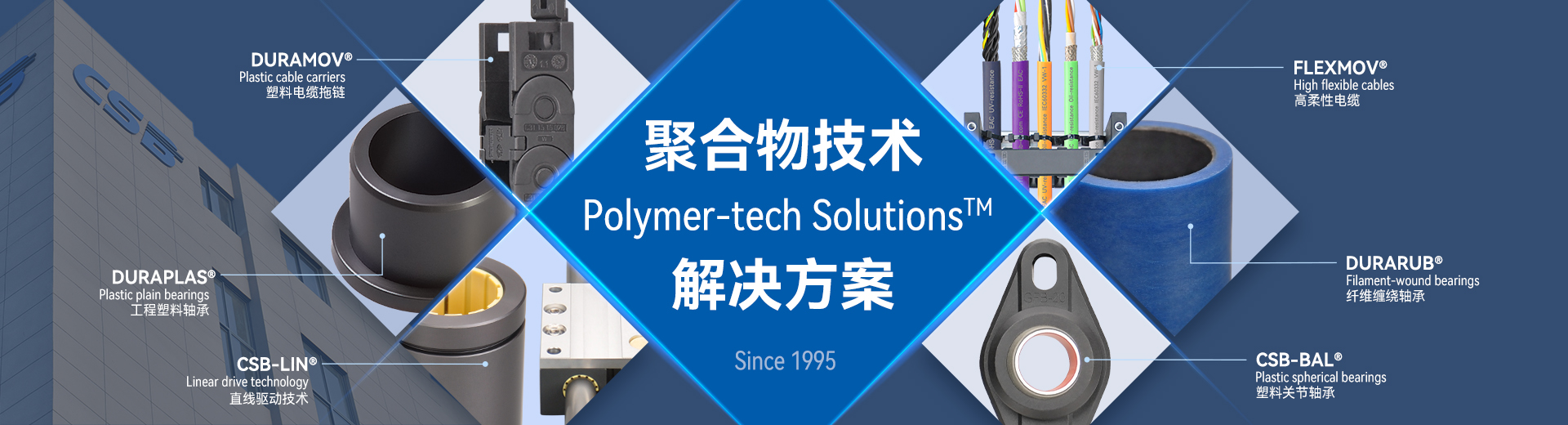
CSB-LIN linear guides all use maintenance-free sliding or roller structures. The sliding elements are all DURAPLAS® wear-resistant composite materials, and the guide bodies are mostly hard-anodized aluminum alloy. They share the common features of contamination resistance, low noise, and lightweight design, but the positioning of each series differs significantly. TR compact guides have external dimensions consistent with standard ball guides on the market. Their lightweight aluminum alloy sliders are dust-resistant and quiet, making them suitable for directly replacing ball guides in automated transfer mechanisms. NR miniature linear guides have a mounting height of only 6-12 mm. They are compact, corrosion-resistant, and suitable for small precision equipment and inspection instruments. WR and WQ square guides are made of hard-anodized aluminum alloy and offer high design freedom, light weight, and contamination resistance. WQ square rails can also achieve torsion-resistant motion. HR and HN are roller guides. Their drive force is only about 10% that of ordinary sliding slide tables, and they allow a maximum operating speed of 10 m/s. HN guide hole positions are compatible with standard ball guides and support splicing for ultra-long strokes. HR roller slide tables have built-in dust wipers and anti-collision buffers, combining high speed and long life. Selection logic: if compatibility with ball guide dimensions is required, choose TR; for narrow equipment space and light-load small mechanisms, choose NR; for torsion resistance and high design freedom, choose WR/WQ; for high speed, low drive force, and ultra-long spliced strokes, prefer HR/HN roller guides. Typical applications: NR miniature guides for 3C inspection equipment; TR for packaging line transfer mechanisms; HN spliced guides for long-stroke sorting equipment. Sliding guides are not suitable for continuous extremely high speeds; for high-speed conditions, prefer HR/HN roller guides. In heavily dusty conditions, rollers with built-in dust wipers have more advantages than pure sliding structures. At the same time, it is also recommended to add protective covers to block hard large-particle debris.