


Necessity of Selecting Anti-Torsion High-Flex Cables for Industrial Robots
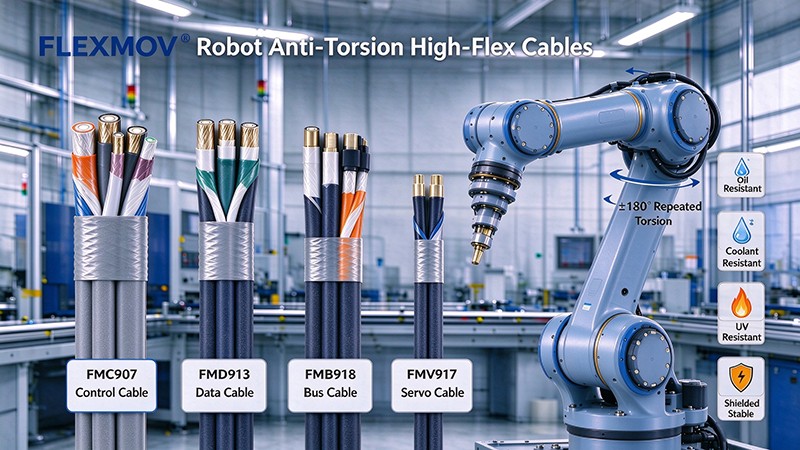
During operation, the wrist and end axes of multi-joint industrial robots continuously undergo ±180° reciprocating torsion. Cables are subject to combined stresses from repeated torsion and bending. Ordinary flexible cables are only designed for simple reciprocating bending and lack anti-torsion construction. If deployed on robot joints, they will trigger multiple equipment risks. When ordinary cables are subjected to repeated twisting, internal conductors tend to suffer fatigue fracture, resulting in signal loss and unexpected equipment shutdown. The insulation layer tears under torsional tension, leading to short circuits and electric leakage. The outer sheath ages and cracks rapidly, allowing oil, coolant and moisture to penetrate into the cable core, which further accelerates cable damage. Frequent spare part replacement pushes up maintenance costs and may even cause robot misoperation, bringing potential safety hazards to production sites. Therefore, adopting FLEXMOV® series dedicated anti-torsion robot cables is critical to ensuring long-term reliable operation of robots.
The FLEXMOV® series features PUR high-performance outer sheaths, engineered specifically for ±180° high-frequency torsion conditions of robots. It covers four major categories: control, data, bus and servo cables, fully meeting the complete electrical transmission requirements of robots. FMC907 control cable is oil-resistant, coolant-resistant and flame-retardant, with an operating temperature range of -50~+80°C, suitable for robot switch control circuits. FMD913 shielded data cable delivers hydrolysis resistance and microbial resistance to guarantee stable data transmission under dynamic working conditions. FMB918 bus cable is flame-retardant and UV-resistant, ideal for bus communication transmission in workshop environments with light exposure, rated for -50~+70°C. FMV917 shielded servo cable is flame-retardant and resistant to wide temperature fluctuations, operating from -55~+80°C, satisfying power and feedback signal transmission for servo motors.
Optimized internal structure relieves internal stress generated by repeated torsion. After millions of torsion cycles, the conductors and shielding structure remain intact. The sheath withstands erosion from oil, coolant and ultraviolet rays. The adoption of FLEXMOV® anti-torsion high-flex cables effectively avoids premature failure of ordinary cables, greatly reduces unplanned downtime, cuts on-site maintenance frequency and extends overall cable service life. It ensures continuous and stable transmission of robot power, control, data and servo signals, making it an indispensable component for multi-axis industrial robots under dynamic operating conditions.