 Polymer-tech SolutionsTM
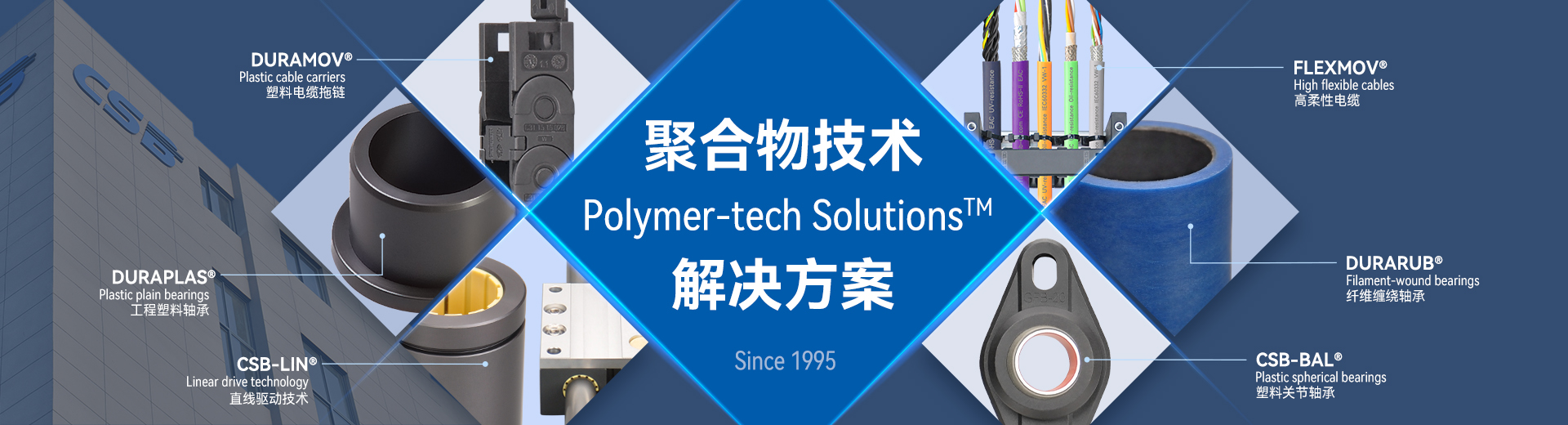
The greatest advantage of CSB-LIN®P precision linear bearings is that they have exactly the same external dimensions and precision as metal ball linear bearings, allowing direct drop-in replacement of ball linear bearings without modifying the mechanical structure. The wear layer uses TEFPLAS® composite material, is self-lubricating and maintenance-free, has a low coefficient of friction, and can operate stably over a wide temperature range from -200°C to +200°C. The small-clearance operating design means the sliding liner not only does not scratch the shaft surface, but also wipes and cleans dust and dirt from the shaft surface during motion, providing a self-cleaning effect. The load capacity is higher than that of ball linear bearings of the same specification, and operating noise is significantly reduced. The product is available in closed, open, and flanged structures. Open models fit supported shafts, while closed models are suitable for through-shaft applications. There is an important selection detail: when the operating speed reaches 0.5 m/s, the ambient temperature exceeds 100°C, or there is a parallelism error in dual-shaft installation, it is recommended to use the standard version on one side and the C-type with clearance compensation on the other side, eliminating the risk of jamming caused by thermal expansion and assembly parallelism. Preferred application scenarios: existing ball bearings frequently fail due to dust, cleaning fluids, or high and low temperatures and need localized replacement; food, low-temperature cold chain, and high-temperature baking equipment; equipment space is limited, and the mounting structure cannot be redesigned, so the user wants to directly reuse the ball bearing housing bore dimensions. Typical equipment: pharmaceutical filling equipment, internal moving mechanisms of high- and low-temperature test chambers, and lithium battery production equipment. For the mating shaft, h6-h7 tolerance is preferred, shaft surface roughness Ra 0.2-0.4, and surface hardness HRC50, which can maximize service life. If the shaft material is soft, the PV value needs to be reduced to reserve a safety margin, avoiding rapid liner wear.